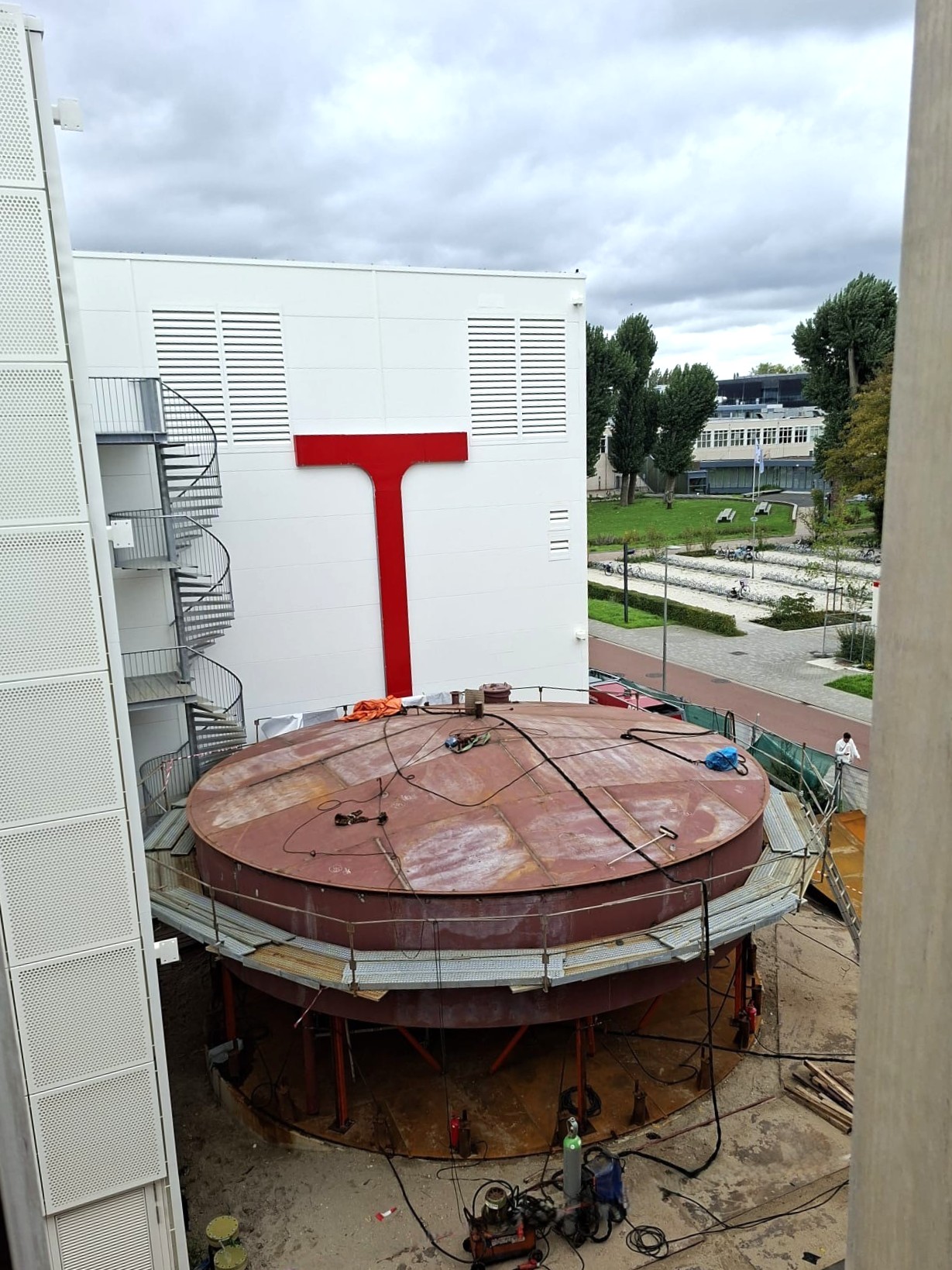

Since September 2026, a prominent above-ground tank has been rising at Geothermie Delft's heating plant: a giant heat buffer. But what exactly is the purpose of such a storage tank, how does it work, and why is it so essential for making Delft and the TU Campus more sustainable? We ask Leon Blokland, Asset Manager at Geothermie Delft.
What exactly is the heat buffer and how does it work?
"The best way to think of the heat buffer is as a massive 1,400-cubic-metre thermos flask filled with water. The principle relies on what we call thermal stratification: warm water is lighter than cold water, which allows the layers to float on top of one another without immediately mixing. The hottest water sits at the top, while the cooled return water from the city and the campus sits at the bottom.
When the demand for heat rises, the buffer supplies extra energy by releasing hot water from the top. Conversely, if there is more heat available than is currently needed, that excess heat is stored in the buffer. In this way, the boundary layer between hot and cold water in the tank shifts, depending on how much heat is being stored or supplied."
Why do we need a storage tank for geothermal energy?
"The geothermal source and the associated above-ground facilities operate best when running as smoothly, steadily, and stably as possible. That is beneficial for the well, the plant itself, and for efficient operations. However, heat consumption in the city fluctuates throughout the day. Consider the morning, when homes and buildings heat up and many people use hot water at the same time, compared to the night when demand is minimal. The heat buffer decouples heat production from demand: it stores heat when we have a surplus and supplies it directly when demand peaks."
What will the campus and the residents of Delft notice as a result?
"It primarily provides security of supply and maximum efficiency. Thanks to the buffer, the geothermal source doesn't need to ramp up or slow down immediately with every fluctuation in heat demand. This makes the overall heating system much more stable. As a result, we make optimal use of the sustainable geothermal heat from the underground source and reduce the need to fall back on peak load or back-up heat sources during busy periods."
How does this buffer fit into Geothermie Delft's overall system?
"In short, Geothermie Delft works with three closed water loops that transfer heat to one another:
The primary loop (underground): Pumps hot well water up from deep underground at a stable rate and transfers its heat via a heat exchanger.
The secondary loop (heat pump plant): Houses the heat buffer. This is the 'distribution hub' where the generated heat can be temporarily stored.
The tertiary loop (district heating network): The pipe network that delivers the stored or directly extracted heat to buildings on the TU Delft Campus and surrounding city neighbourhoods."
Leon, as Asset Manager, what is your role in the construction of this buffer?
"The actual construction and engineering lie with our project team and contractors, of course. My role focuses mainly on integrating the buffer into our overall operations—after all, it is one piece of a larger puzzle. Together with technical partners, I look at how the buffer will seamlessly interact with the geothermal source, heat pumps, district heating networks, and other energy sources. I also keep an eye on the future: how do we ensure the facility can be managed and maintained safely, reliably, and efficiently down the line?"
How is the coordination between all these facilities managed?
"That is handled by a smart, overarching Operational Control System (BVR). This automated system continuously monitors weather forecasts, historical consumption profiles, and current storage levels in the heat buffer. For example, if we expect a cold morning, the system ensures the buffer is charged overnight. It is a complex interplay of automation and smart modelling that ensures every heat source delivers peak performance at just the right time."
When will the heat buffer be ready for use?
"The completion of the heat buffer runs alongside the construction of the heating plant. The buffer is expected to be fully operational in the second half of 2027, ready to provide Delft with smart, sustainable heat."