
Since February 2026, Geothermie Delft has been providing clean, sustainable heat from a depth of over two kilometres to university buildings and student accommodation on the TU Delft Campus. Alongside the geothermal source, GTD guarantees its heat supply using various supporting solutions, such as High-Temperature Aquifer Thermal Energy Storage (HT-ATES / HTO).
With HT-ATES, we are working on a sustainable solution to store heat in the shallow subsurface.
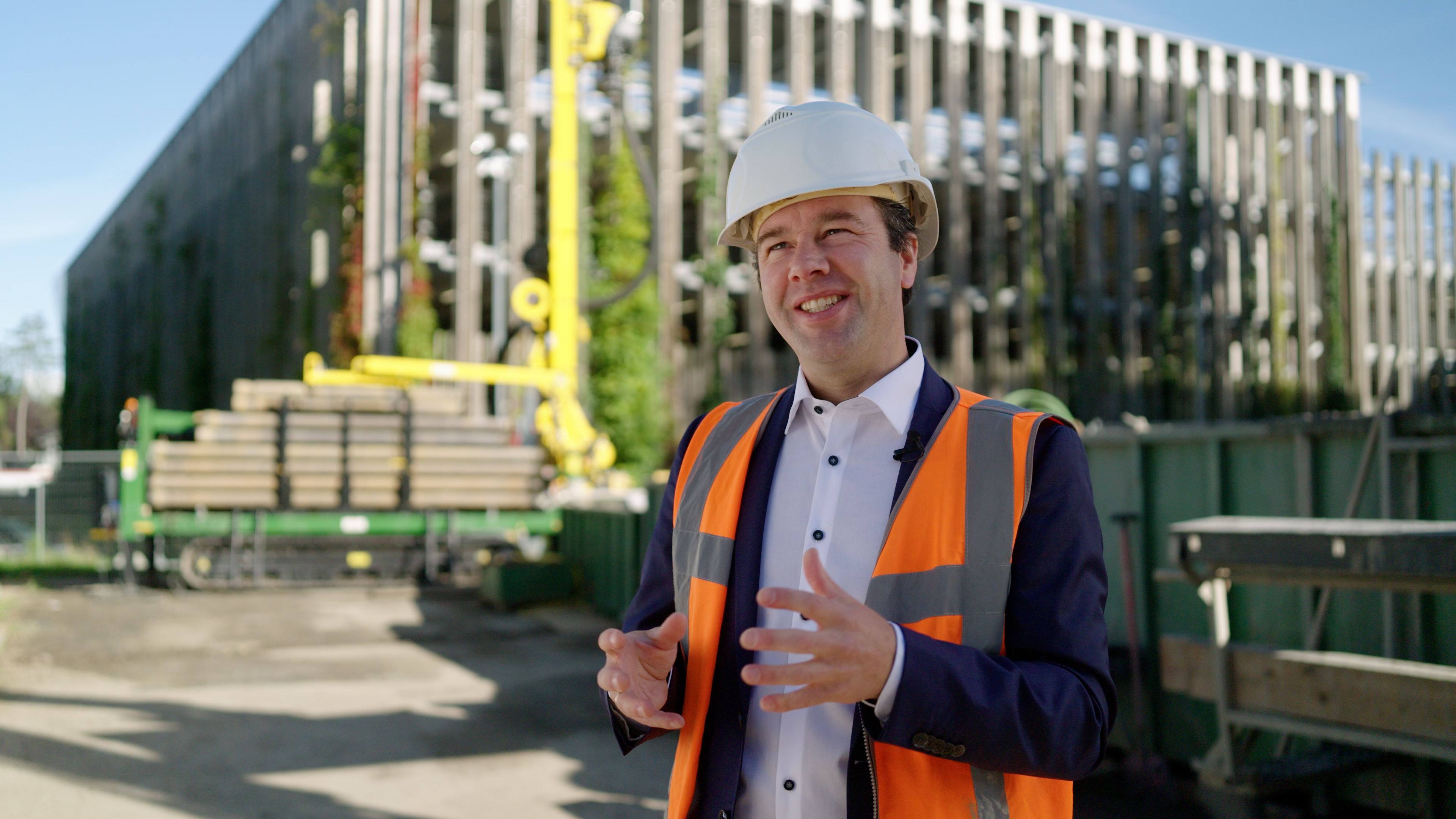
Martin Bloemendal, Associate professor and researcher at TU Delft, explains how this works.
What exactly is your role at TU Delft?
MB: "I am a researcher and associate professor at TU Delft, focusing on sustainable heating and cooling systems. My primary focus is on storing heat in the subsurface—a technology known as underground thermal energy storage. In addition, I lead the European research project PUSH-IT, in which we develop and test these types of underground storage systems in practice."
Why is underground heat storage so important for our energy transition?
MB: "Around a quarter of all our energy consumption goes towards heating and cooling buildings. Naturally, our highest heat demand occurs in winter. Because we use very little geothermal heat in Delft during the summer, we end up with a surplus of unused heat. However, we can store that energy for later use. HT-ATES allows us to preserve that heat underground.
Why is GTD storing heat in the subsurface?
When you produce a lot of heat in summer and want to use it to cover the heating demands of neighbourhoods or cities in winter, you need enormous storage volumes. Storing that volume of hot water above ground in storage tanks would require a vast amount of surface space, which is both precious and scarce in urban areas. Subsurface storage has the advantage of being completely invisible and roughly ten times cheaper than above-ground heat storage. For other types of heat sources, HT-ATES also offers significant added value to make future energy systems reliable, resilient, and—above all—affordable and sustainable."
How does TU Delft's heat source fit into this?
MB: "On our campus, we utilise geothermal energy—earth heat—pumping up hot water year-round from a well over two kilometres deep. In summer, we barely need that heat. Instead of letting that energy go to waste, we store the summer surplus underground. In winter, when the geothermal source alone isn't enough to meet peak demand, we extract our stored summer heat again for the campus and the city of Delft. This avoids the need to turn on gas boilers at those peak times."
The abbreviation for the technology is HT-ATES. What is it and how does it work exactly?
MB: "We are building a High-Temperature Aquifer Thermal Energy Storage (HT-ATES) system in a sand layer. An aquifer is a water-bearing layer of sand in the ground. For our project in Delft, this layer is located at a depth of between 120 and 180 metres. Because we store water in it at around 90 °C—a much higher temperature than the usual 15 °C found underground—we refer to it as High-Temperature ATES (HT-ATES).
The system consists of five wells drilled into the sand layer: two 'hot' wells and three 'lukewarm' wells.
In summer: The lukewarm wells contain water at 50 to 60 °C, which has already been heated using energy from the geothermal source. We heat the water from these lukewarm wells further—up to 90 °C—via a heat exchanger using surplus geothermal heat. We then inject this into the hot wells. This creates a massive 'plume' or 'bubble' of hot water underground, with a diameter of up to 120 metres.
In winter: We reverse the flow direction. We pump up the hot water to heat the buildings. The cooled water then flows back into the lukewarm wells. Thus, the flow direction reverses with each season."
Why are there more lukewarm wells than hot wells?
MB: "That comes down to the viscosity—the thickness—of water. Cold or lukewarm water flows less easily through sand than hot water does. To move the same volume of water at the same rate, we simply need more wells on the lukewarm side."
What is currently happening at the GTD site?
MB: "We are currently drilling the first wells on the lukewarm side to their final depth of 180 metres. Earlier, we mapped the subsurface through extensive test drilling, so we now know exactly where the suitable sand layers are located."
What are you researching during construction and operation?
"We are monitoring several aspects of underground heat storage:
What can other cities and district heating companies learn from this project?
MB: "One of the key lessons here in Delft is that seasonal heat storage isn't a standalone add-on that you can quickly hook up to a heating network after the fact. From day one, it must be fully integrated into the overall energy system. That is the only way to exploit its full capacity while keeping the heat network affordable and high quality."
What are you proud of, what your personally drive working at GTD?
MB: "I want to make a tangible and meaningful contribution to the energy transition. I find the interconnection of it all fascinating: from the microscopic details of heat transfer between sand grains deep underground, to the grand scale of a fully functioning municipal network. It is immensely rewarding to work alongside so many different experts to build a system that ultimately ensures Delft residents have an affordable, sustainably heated home and students sit in warm lecture halls. And those same students learn firsthand how to apply HT-ATES and various other sustainable technologies in their future careers to help deliver the energy transition."