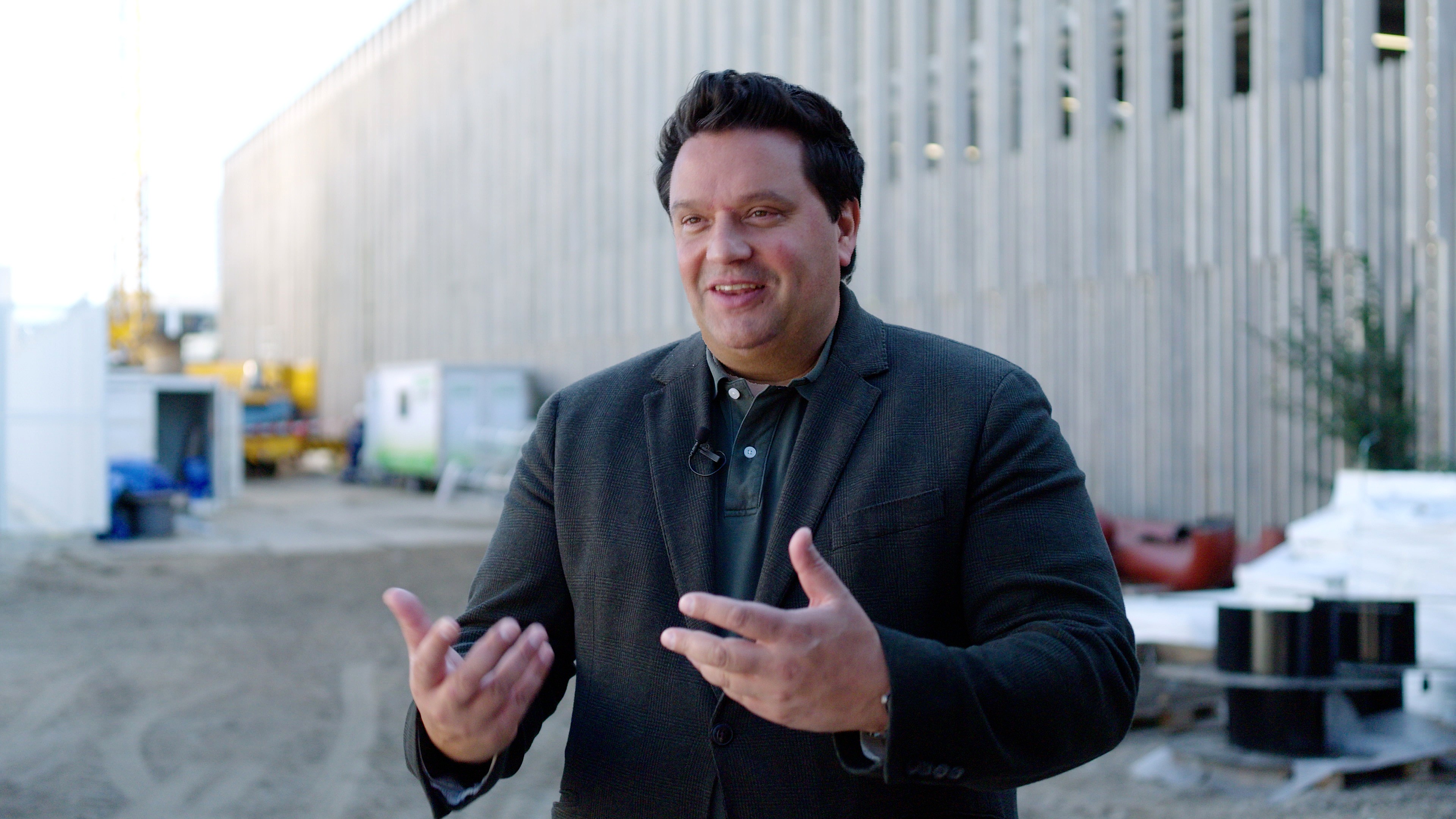

With the construction of the largest High-Temperature Aquifer Thermal Energy Storage (HT-ATES) facility in the Netherlands, Geothermie Delft is taking a crucial step in the energy transition for heat. Managing Director Rass Butt explains how this innovative storage system ensures maximum security of supply, continuity, and reliable sustainable heat for both the TU Delft Campus and the city's residential areas.
What exactly does Geothermie Delft do?
"Geothermie Delft is a large-scale geothermal facility located on the TU Delft campus grounds, producing sustainable heat for both the campus and the city of Delft. Our mission is to drastically reduce CO₂ emissions in the process. The geothermal source is backed up by various additional heat sources that ensure absolute security of supply."
What stage is the project in right now?
"The geothermal plant has been operational since February this year, and we are immensely proud of that. In the very first weeks of operation, we already managed to cut CO₂ emissions significantly.
Because we want to guarantee and enhance the reliability of the geothermal facility, it is supported by several additional heat sources. That is why we are currently fully focused on the next phase: an integrated system combining multiple sources. The core is the main geothermal plant, which draws heat from deep underground. As a backup and peak-load facility, we have created a link to TU Delft’s existing combined heat and power plant (CHP). Alongside this, we are currently constructing a heat pump station, an above-ground thermal buffer, and a vital link: the HT-ATES system."
Why is the HT-ATES facility so important for the project?
"Geothermal energy is produced year-round, but heat demand is of course much higher in winter than in summer. By constructing one of the largest underground HT-ATES systems in Europe, we can store the surplus sustainable heat generated during summer deep underground for the long term. In winter, we pump that heat back up to add extra capacity to the heat network. This allows us to make optimal use of our heat production."
What is the ultimate ambition for Delft?
"We are currently supplying buildings and homes on the TU Delft Campus. At the moment, the heat network is being expanded to reach 6,000 homes outside the campus. Our ultimate goal is to eventually provide 15,000 homes and buildings in Delft with sustainable heat. That accounts for roughly 30\% of the city’s total heat demand. For the TU Delft campus, it is already delivering substantial reductions in CO₂ emissions."
What does this project mean for the Dutch energy transition?
"This is a massive step forward, not just locally for the Municipality of Delft, but for the whole of the Netherlands. Everyone recognises that the heat transition places high demands on all parties involved. But the results we are achieving here simply prove that it can be done. If we all pull together, a sustainable energy system is genuinely within reach."
What drives you personally in your role as Managing Director of Geothermie Delft?
"For me, this project sits right at the intersection of commercial efficiency and social impact. In my work, I always seek out that balance. As a director, you are often judged on financial performance, but above all, I want to make a tangible difference. Social return and community impact are just as important to me. It is precisely this combination that motivates me every day to make this project a success."